| Defined in header <ranges>
|
||
| Defined in header <iterator>
|
||
| inline namespace /* unspecified */ { inline constexpr /* unspecified */ cbegin = /* unspecified */; } |
(since C++20) (customization point object) |
|
| Call signature |
||
| template< class T > requires /* see below */ constexpr /* see below */ auto cbegin( T&& t ); |
(since C++20) | |
|
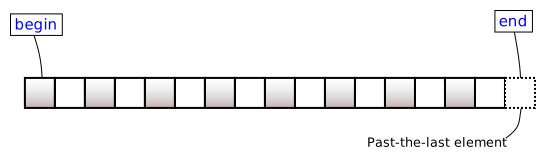
Returns an iterator to the first element of the const-qualified argument. |
(until C++23) |
|
Returns a constant iterator to the first element of the argument. |
(since C++23) |
|
Let
A call to |
(until C++23) |
|
If the argument is an lvalue or
In all other cases, a call to |
(since C++23) |
The return type models std::input_or_output_iterator and constant-iterator(since C++23) in all cases.
Customization point objects
The name ranges::cbegin denotes a customization point object, which is a const function object of a literal semiregular class type. For exposition purposes, the cv-unqualified version of its type is denoted as __cbegin_fn.
All instances of __cbegin_fn are equal. The effects of invoking different instances of type __cbegin_fn on the same arguments are equivalent, regardless of whether the expression denoting the instance is an lvalue or rvalue, and is const-qualified or not (however, a volatile-qualified instance is not required to be invocable). Thus, ranges::cbegin can be copied freely and its copies can be used interchangeably.
Given a set of types Args..., if std::declval<Args>()... meet the requirements for arguments to ranges::cbegin above, __cbegin_fn models
-
std::invocable<__cbegin_fn, Args...>, -
std::invocable<const __cbegin_fn, Args...>, -
std::invocable<__cbegin_fn&, Args...>, and -
std::invocable<const __cbegin_fn&, Args...>.
Otherwise, no function call operator of __cbegin_fn participates in overload resolution.
Notes
For an lvalue range e of type T, ranges::cbegin(e) is equivalent to
| (until C++23) | |
|
(since C++23) |
Example
#include <cassert>
#include <ranges>
#include <vector>

int main()
{
    std::vector v{3, 1, 4};
    auto vi = std::ranges::cbegin(v);
    assert(3 == *vi);
    ++vi; // OK, constant-iterator object is mutable
    assert(1 == *vi);
    // *vi = 13; // Error: constant-iterator points to an immutable element

    int a[]{3, 1, 4};
    auto ai = std::ranges::cbegin(a); // cbegin works with C-arrays as well
    assert(3 == *ai and *(ai + 1) == 1);
    // *ai = 13; // Error: read-only variable is not assignable
}
See also
| (C++20) |
returns an iterator to the beginning of a range (customization point object) |
| (C++11)(C++14) |
returns an iterator to the beginning of a container or array (function template) |
Content from this page on cppreference.com, licensed under CC-BY-SA 3.0 and GFDL. Modified: restyled, site navigation removed, code windows added. Offline snapshot of 9 February 2025.