| Defined in header <array>
|
||
| Defined in header <deque>
|
||
| Defined in header <flat_map>
|
||
| Defined in header <flat_set>
|
||
| Defined in header <forward_list>
|
||
| Defined in header <inplace_vector>
|
||
| Defined in header <iterator>
|
||
| Defined in header <list>
|
||
| Defined in header <map>
|
||
| Defined in header <regex>
|
||
| Defined in header <set>
|
||
| Defined in header <span>
|
||
| Defined in header <string>
|
||
| Defined in header <string_view>
|
||
| Defined in header <unordered_map>
|
||
| Defined in header <unordered_set>
|
||
| Defined in header <vector>
|
||
template< class C > auto rend( C& c ) -> decltype(c.rend()); |
(1) | (since C++14) (constexpr since C++17) |
template< class C > auto rend( const C& c ) -> decltype(c.rend()); |
(2) | (since C++14) (constexpr since C++17) |
template< class T, std::size_t N > std::reverse_iterator<T*> rend( T (&array)[N] ); |
(3) | (since C++14) (constexpr since C++17) |
template< class T > std::reverse_iterator<const T*> rend( std::initializer_list<T> il ); |
(4) | (since C++14) (constexpr since C++17) |
template< class C > auto crend( const C& c ) -> decltype(std::rend(c)); |
(5) | (since C++14) (constexpr since C++17) |
Returns an iterator to the reverse-end of the given range.
1,2) Returns
c.rend(), which is typically an iterator one past the reverse-end of the sequence represented by c.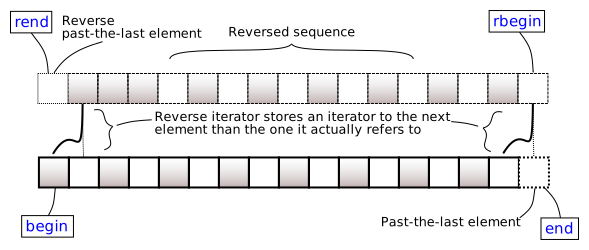
Parameters
| c | - | a container or view with a rend member function
|
| array | - | an array of arbitrary type |
| il | - | an std::initializer_list |
Return value
1,2)
c.rend()3)
std::reverse_iterator<T*>(array)4)
std::reverse_iterator<const T*>(il.begin())5)
c.rend()Exceptions
May throw implementation-defined exceptions.
Overloads
Custom overloads of rend may be provided for classes and enumerations that do not expose a suitable rend() member function, yet can be iterated.
|
Overloads of |
(since C++20) |
Notes
The overload for std::initializer_list is necessary because it does not have a member function rend.
Example
#include <algorithm>
#include <iostream>
#include <iterator>
#include <vector>

int main()
{
    int a[]{4, 6, -3, 9, 10};
    std::cout << "C-style array `a` backwards: ";
    std::copy(std::rbegin(a), std::rend(a), std::ostream_iterator<int>(std::cout, " "));

    auto il = {3, 1, 4};
    std::cout << "\nstd::initializer_list `il` backwards: ";
    std::copy(std::rbegin(il), std::rend(il), std::ostream_iterator<int>(std::cout, " "));

    std::vector<int> v{4, 6, -3, 9, 10};
    std::cout << "\nstd::vector `v` backwards: ";
    std::copy(std::rbegin(v), std::rend(v), std::ostream_iterator<int>(std::cout, " "));
    std::cout << '\n';
}C-style array `a` backwards: 10 9 -3 6 4
std::initializer_list `il` backwards: 4 1 3
std::vector `v` backwards: 10 9 -3 6 4See also
| (C++11)(C++14) |
returns an iterator to the end of a container or array (function template) |
| (C++14) |
returns a reverse iterator to the beginning of a container or array (function template) |
| (C++11)(C++14) |
returns an iterator to the beginning of a container or array (function template) |
| (C++20) |
returns a reverse end iterator to a range (customization point object) |
| (C++20) |
returns a reverse end iterator to a read-only range (customization point object) |
Content from this page on cppreference.com, licensed under CC-BY-SA 3.0 and GFDL. Modified: restyled, site navigation removed, code windows added. Offline snapshot of 9 February 2025.