| Defined in header |
||
| float ceilf( float arg ); |
(1) | (since C99) |
| double ceil( double arg ); |
(2) | |
| long double ceill( long double arg ); |
(3) | (since C99) |
| Defined in header |
||
| #define ceil( arg ) |
(4) | (since C99) |
arg.arg has type long double, ceill is called. Otherwise, if arg has integer type or the type double, ceil is called. Otherwise, ceilf is called.Parameters
| arg | - | floating-point value |
Return value
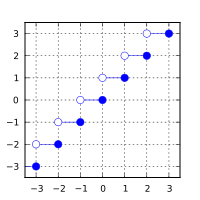
If no errors occur, the smallest integer value not less than arg, that is ⌈arg⌉, is returned.
Error handling
Errors are reported as specified in math_errhandling.
If the implementation supports IEEE floating-point arithmetic (IEC 60559):
- The current rounding mode has no effect.
- If
argis ±∞, it is returned, unmodified. - If
argis ±0, it is returned, unmodified. - If
argis NaN, NaN is returned.
Notes
FE_INEXACT may be (but isn't required to be) raised when rounding a non-integer finite value.
The largest representable floating-point values are exact integers in all standard floating-point formats, so this function never overflows on its own; however the result may overflow any integer type (including intmax_t), when stored in an integer variable.
This function (for double argument) behaves as if (except for the freedom to not raise FE_INEXACT) implemented by
#include <fenv.h>
#include <math.h>
#pragma STDC FENV_ACCESS ON

double ceil(double x)
{
    double result;
    int save_round = fegetround();
    fesetround(FE_UPWARD);
    result = rint(x); // or nearbyint
    fesetround(save_round);
    return result;
}
Example
#include <math.h>
#include <stdio.h>

int main(void)
{
    printf("ceil(+2.4) = %+.1f\n", ceil(2.4));
    printf("ceil(-2.4) = %+.1f\n", ceil(-2.4));
    printf("ceil(-0.0) = %+.1f\n", ceil(-0.0));
    printf("ceil(-Inf) = %+f\n",   ceil(-INFINITY));
}ceil(+2.4) = +3.0
ceil(-2.4) = -2.0
ceil(-0.0) = -0.0
ceil(-Inf) = -infReferences
- C23 standard (ISO/IEC 9899:2024):
- 7.12.9.1 The ceil functions (p: TBD)
- 7.25 Type-generic math <tgmath.h> (p: TBD)
- F.10.6.1 The ceil functions (p: TBD)
- C17 standard (ISO/IEC 9899:2018):
- 7.12.9.1 The ceil functions (p: TBD)
- 7.25 Type-generic math <tgmath.h> (p: TBD)
- F.10.6.1 The ceil functions (p: TBD)
- C11 standard (ISO/IEC 9899:2011):
- 7.12.9.1 The ceil functions (p: 251)
- 7.25 Type-generic math <tgmath.h> (p: 373-375)
- F.10.6.1 The ceil functions (p: 526)
- C99 standard (ISO/IEC 9899:1999):
- 7.12.9.1 The ceil functions (p: 231-232)
- 7.22 Type-generic math <tgmath.h> (p: 335-337)
- F.9.6.1 The ceil functions (p: 462-463)
- C89/C90 standard (ISO/IEC 9899:1990):
- 4.5.6.1 The ceil function
See also
| (C99)(C99) |
computes largest integer not greater than the given value (function) |
| (C99)(C99)(C99) |
rounds to nearest integer not greater in magnitude than the given value (function) |
| (C99)(C99)(C99)(C99)(C99)(C99)(C99)(C99)(C99) |
rounds to nearest integer, rounding away from zero in halfway cases (function) |
| (C99)(C99)(C99) |
rounds to an integer using current rounding mode (function) |
| (C99)(C99)(C99)(C99)(C99)(C99)(C99)(C99)(C99) |
rounds to an integer using current rounding mode with exception if the result differs (function) |
| C++ documentation for ceil
| |
Content from this page on cppreference.com, licensed under CC-BY-SA 3.0 and GFDL. Modified: restyled, site navigation removed, code windows added. Offline snapshot of 9 February 2025.